Ads 468x60px

freak2code is the blog about latest geek news,software reviews ,trends in technology and more informative stuff......

Wednesday, 19 September 2012

Exploit Released for Zero-Day in Internet Explorer


Exploit Released for Zero-Day in Internet Explorer

 
by vinay gautam
 
 
A working exploit that takes advantage of a previously unknown critical security hole in Internet Explorer has been published online. Experts say the vulnerability is being actively exploited in the wild, and that it appears to be connected to the same group of Chinese hackers responsible for unleashing a pair of Java zero-day exploits late last month.
Researchers at security vulnerability testing firm Rapid7 have added a new module to the company’s free Metasploit framework that allows users to successfully attack the vulnerability on Internet Explorer versions 7, 8 and 9 on Windows XP, Vista and 7.
“Computers can get compromised simply by visiting a malicious website, which gives the attacker the same privileges as the current user,” Rapid7 researcher “sinn3r” wrote on the firm’s blog. “Since Microsoft has not released a patch for this vulnerability yet, Internet users are strongly advised to switch to other browsers, such as Chrome or Firefox, until a security update becomes available. The exploit had already been used by malicious attackers in the wild before it was published in Metasploit. The associated vulnerability puts about 41% of Internet users in North America and 32% world-wide at risk.”
News of the IE exploit surfaced at the blog of security researcher and blogger Eric Romang, who said he discovered the attack code while examining a Web server recently used by Chinese hackers to launch targeted attacks via zero-day Java vulnerabilities that were patched by Oracle last month. Romang and other experts have connected the sites serving those Java exploits to the Nitro attacks of 2011, espionage attacks directed against at least 48 chemical and defense companies.
I pinged Microsoft for a comment but have not yet heard back from them. I suspect they are preparing an advisory about this threat, and will update this post when I receive a response. Until an official fix is available, IE users would be wise to surf with another browser.

Internet Explorer Users: Please Read This


Internet Explorer Users: Please Read This

by vinay gautam

Microsoft is urging Windows users who browse the Web with Internet Explorer to use a free tool called EMETto block attacks against a newly-discovered and unpatched critical security hole in IE versions 7, 8 and 9. But some experts say that advice falls short, and that users can better protect themselves by surfing with an alternative browser until Microsoft issues a proper patch for the vulnerability.
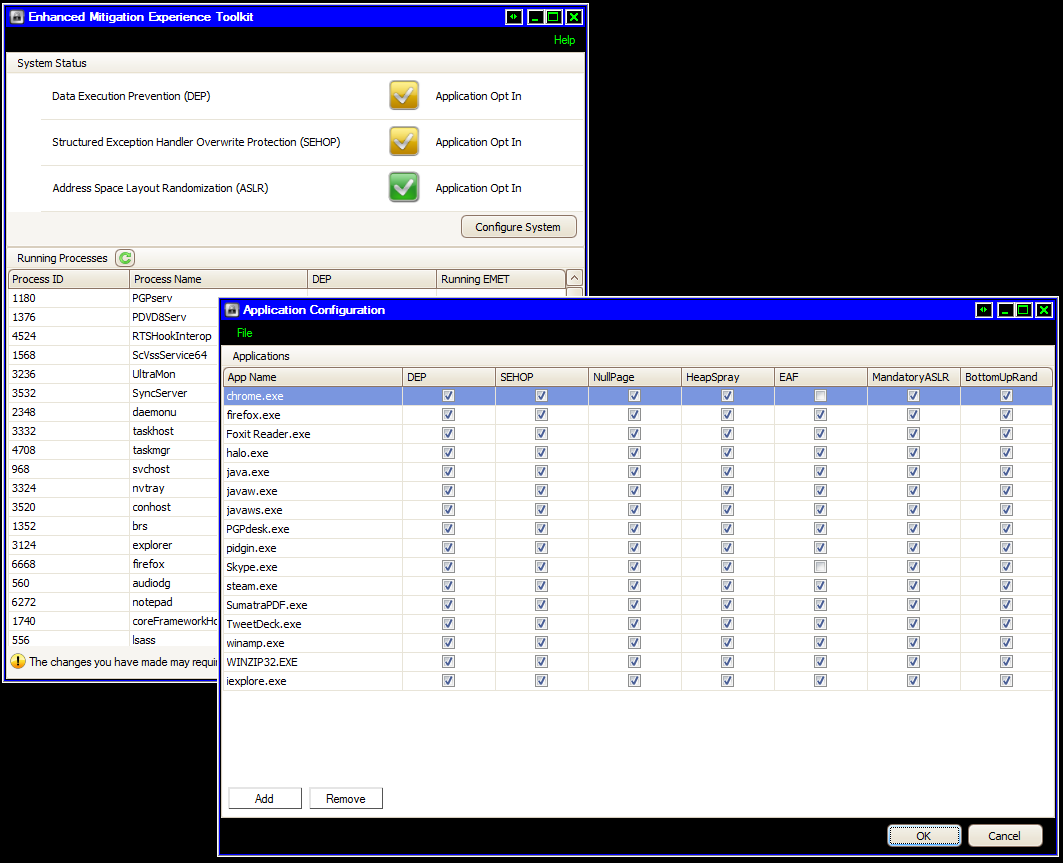
The application page of EMET.
EMET, short for the Enhanced Mitigation Experience Toolkit, is a tool that can help Windows users beef up the security of commonly used applications, whether they are made by a third-party vendor or by Microsoft. EMET allows users to force applications to use one or both of two key security defenses built into Windows Vista andWindows 7 — Address Space Layout Randomization (ASLR) and Data Execution Prevention (DEP).
Put very simply, DEP is designed to make it harder to exploit security vulnerabilities on Windows, and ASLR makes it more difficult for exploits and malware to find the specific places in a system’s memory that they need to do their dirty work.
Before I get into the how-tos on EMET, a few caveats. EMET is a great layer of security that Windows users can and should use to enhance the security of applications. But EMET may not block the exploit code now publicly available through the Metasploit framework. In fact, Tod Beardlsey, an engineering manager with Rapid7, the security firm that manages Metasploit, told The Associated Press that EMET does not appear to be completely effective against this exploit.
I asked Metasploit founder HD Moore what he thought was the best way to block this exploit, and he pointed out that the exploit available through Metasploit requires the presence of Java on the host machine in order to execute properly on IE 8/9 on Windows 7 and Vista systems (the exploit works fine without Java against IE7 on XP/Vista and IE8 on XP). Obviously, while the lack of Java on a Windows machine may not prevent other exploits against this flaw, it is a great first start. I have consistently urged computer users of all stripes to uninstall Java if they have no specific use for it.

Using a non-IE browser such as Chrome, Firefox, Opera or Safari is a far safer approach, at least until Microsoft releases a proper patch for this flaw (note that Windows 8 and Internet Explorer 10 are not affected by this vulnerability).
If you decide to stick with IE, I’d encourage you to read closely the security advisory Microsoft published last night. It describes a number of tweaks that users can make to ratchet up security settings in IE, and details the process of setting up IE to use EMET.
EMET can force individual applications to perform ASLR on every component they load, whether the program wants it or not. Please note that before you install EMET, you’ll need to have Microsoft’s .NET platform installed. And while it does technically work on Windows XP (Service Pack 3 only), XP users cannot take advantage of mandatory ASLR and some of the other notable protections included in this tool.
To proceed with EMET, download the program and install it. To wrap Internet Explorer in EMET’s settings, launch the program and click the “Configure Apps” button in the bottom right corner of the application window. Selecting the “Add” button in the next box that brings up a program selection prompt; browse to C:\Program Files\Internet Explorer, and then add the “iexplore.exe” file. It should be okay to accept all of the defaults that EMET adds for you.
While you’re at it, add the rest of your more commonly used, Internet-facing apps. But go slow with it, and avoid the temptation to make system-wide changes. Changing system defaults across the board – such as changing ASLR and DEP settings using the “configure system” tab – may cause stability and bootup problems. I’ve been using it on a 64-bit Windows 7 system and phasing in some of my most-used applications on-by-one with the “configure apps” button just to make sure the added security doesn’t crash the programs (see screen shot below). So far, the only problem I’ve run up against was Skype, which didn’t seem to like being forced into using the six different protection mechanisms that EMET employs by default when you manually add application: It simply would crash upon startup.

Malware Dragnet Snags Millions of Infected PCs


Malware Dragnet Snags Millions of Infected PCs

by vinay gautam

Last week, Microsoft Corp. made headlines when it scored an unconventional if not unprecedented legal victory: Convincing a U.S. court to let it seize control of a Chinese Internet service provider’s network as part of a crackdown on piracy.
I caught up with Microsoft’s chief legal strategist shortly after that order was executed, in a bid to better understand what they were seeing after seizing control over more than 70,000 domains that were closely associated with distributing hundreds of strains of malware. Microsoft said that within hours of the takeover order being granted, it saw more than 35 million unique Internet addresses phoning home those 70,000 malicious domains.
First, the short version of how we got here: Microsoft investigators found that computer stores in China were selling PCs equipped with Windows operating system versions that were pre-loaded with the “Nitol” malware, and that these systems were phoning home to subdomains at 3322.org. The software giant subsequently identified thousands of sites at 3322.org that were serving Nitol and hundreds of other malware strains, and convinced a federal court in Virginia to grant it temporary control over portions of the dynamic DNS provider.
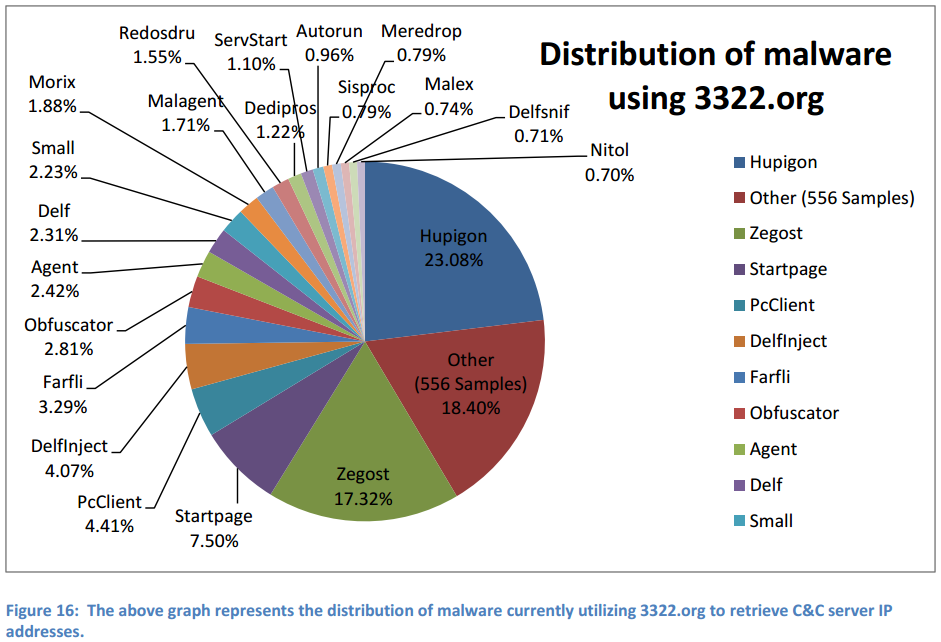
Microsoft was able to do that because – while 3322.org is owned by a firm in China — the dot-org registry is run by a company based in Virginia. Yet, as we can see from the graphic above provided by Microsoft, Nitol infections were actually the least of the problems hosted at 3322.org (more on this later).
To learn more about the outcome of the seizure, I spoke with Richard Boscovich, a senior attorney with the company’s digital crimes unit (DCU) who helped to coordinate this action and previous legal sneak attacks against malware havens. Our interview came just hours after Microsoft had been cleared to seize control over the 70,000+ subdomains at 3322.org. I asked Boscovich to describe what the company was seeing.
“The numbers are quite large,” he said. “Just a quick view of what we’ve been seeing so far is upwards of 35 million unique IP [addresses] trying to connect with the 70,000 subdomains.”
Certainly IP addresses can be very dynamic — a single computer can have multiple IP addresses over a period of a few days, for example. But even if there were half as many infected PCs than unique IPs that Microsoft observed reporting to those 70,000 domains, we’d still be talking about an amalgamation of compromised PCs that is far larger than any known botnet on the planet today.  So how certain was Microsoft that these 35 million unique IPs were in fact infected computers?
“We started identifying what our AV company blocks,” Boscovich explained. “We saw a lot of different types of malware, from keyloggers to DDoS tools and botnets going back there. Our position would be if you’re reaching out to these 70,000 subdomains, that the purpose would be you’re directed there to be infected or you are already infected with something. And that something was up to 560 or so malware strains we identified [tracing back] to 3322.org.”
COLLATERAL DAMAGE?
Microsoft’s past unilateral actions against malware purveyors and botnets have engendered their share of harshreactions from members of the security community, and I fully expected this one also would be controversial. I wasn’t disappointed: Writing for Internet policy news site CircleID, longtime antispam activist Suresh Ramasubramanian warned that Microsoft’s action would cause “extremely high collateral damage,” both to innocent sites and to ongoing investigations.
“So, in the medium to long term run …all that Microsoft DCU and Mr. Boscovitch have achieved are laudatory quotes in various newspapers and a public image as fearless and indefatigable fighters waging a lone battle against cybercrime,” Ramasubramanian wrote. “That manifestly is not the case. There are several other organizations (corporations, independent security researchers, law enforcement across several countries) that are involved in studying and mitigating botnets, and a lot of their work just gets abruptly disrupted (jeopardizing ongoing investigations, destroying evidence and carefully planted monitoring).”

Boscovich said Microsoft worked hard to focus its legal request on 3322.org subdomains that appeared to be doing little else than serving as controllers, updaters or data repositories for malware operations. He noted that the 70,000 domains the court granted it control over were only a small subset (less than 3 percent) of the 2.75 million subdomains currently host at 3322.org.
“There’s always a balancing act,” the Microsoft lawyer told me. “You want to make sure you do it in such a way to minimize collateral damage on legitimate sites. The unique aspect of this action was the great lengths that we went to make sure that we surgically took out and sinkholed 70,000 subdomains out of a domain hosting 2.75 million subdomains total. We developed technology along with Nominum where we were able to — once a domain was pointed to us — to only take out those 70,000, allowing all of the other subdomains which are beyond the scope of our order to simply resolve and not be impacted.”
Boscovich added that Microsoft and Nominum will be working with Internet service providers to help clean machines seen reporting to the hostile 3322.org sites.
“A lot of people in the security community like to do a lot of research, they like sit on these things and see what’s happening, but sometimes the right thing to do is get to the victims, tell them that they’ve been victimized, tell them that they’re victimizing others, and help clean them up,” he said.
Other luminaries in the security research space expressed surprise at the breadth of Microsoft’s latest legal action, but said it was too soon to say how much of an impact it would have on the malware ecosystem. Dan Hubbard, chief technology officer at OpenDNS, said his firm has been blocking all 2.75 million subdomains at 3322.org for almost two years.
“We very rarely get complaints, and even today we see 1.1 million requests [attempting to go to] 3322.org with zero complaints,” Hubbard said. “The vast majority of it is not good.”
But he said he wonders what Microsoft is going to do with all of the sensitive information flowing through the sinkholed 3322.org domains. As I noted in my previous piece, subdomains at 3322.org have long been associated with targeted malware used in espionage attacks against U.S. and other Western corporations.
“There is going to be quite a bit of sensitive information that’s coming across the flow, from credit card details to proprietary company records,” Hubbard said. “It will be interesting to know what are the bounds around that, what they do with that data, and are they going to inform companies that are impacted.”
Joe Stewart, a senior security analyst with Dell SecureWorks, agreed, calling the scope of the interception order “unprecedented.”
“It’s a little bit surprising that Microsoft went to the lengths they did,” Stewart said. “That they are intercepting or trying to intercept millions of malicious requests while still allowing service to operate is unprecedented, sort of like they’re acting as ‘the great firewall of Microsoft.’ It’s not the sinkholing of these subdomains that’s novel, it’s that they’ve injected themselves legally between this service in China and its users. Handled responsibly, it could be a good thing.”
WILL THE REAL JOHN DOE PLEASE STEP FORWARD?
Like others before it, this latest legal salvo by Microsoft seeks to unmask individuals behind the alleged criminal activity at 3322.org. It does this using so-called “John Doe,” requests, which are legal proceedings that can enable a plaintiff or prosecutor to gather information on a number of individuals, in a bid to learn their identities and/or to prove they were parties to a conspiracy.
I asked Boscovich if Microsoft’s John Doe requests in previous targeted botnet takedowns had produced any leads. Specifically, I wanted to know if there were any updates to the John Does named in connection with itstargeting of the Kelihos spam botnet. In that case, Microsoft identified 31-year-old Andrey N. Sabelnikov of St. Petersburg, Russia, a former system developer and project manager for Agnitum, a Russian antivirus firm.
“In the Kelihos case, we named the Russian AV…the individual that we alleged was the developer of the code for Kelihos,” Boscovich said. “We’re resolving that case now, and very shortly you’ll hear a statement that will be coming out.”
Shortly after that story broke, Sabelnikov vehemently refuted Microsoft’s allegations, saying he had never participated in the management of botnets or any other similar programs. But according to Boscovich, Microsoft will soon be publishing a statement that says otherwise.
“I think that once you see the statement that he agreed to that we’re going to publish in the next couple of days on the Kelihos case, I think that will put that to rest. I think we’ve been pretty accurate that when we name someone we know who they are. And there have been a lot of cases referred to law enforcement, and a lot of the evidence based upon which they’re much further along now based upon the stuff that we have done. So anybody who thinks that these things are not effective, from purely an identification of individuals behind it is concerned, they’re wrong.”

Android 4.1 Jelly Bean user base grew 1,500% in two months


Android 4.1 Jelly Bean user base grew 1,500% in two months

by vinay gautam

Since it’s announcement two months ago, Jelly Bean has seen a spike in its users by a whopping 1,500%. Advertising network and research firm Chitika compiled millions and millions of mobile ad impressions from within its network and calculated that Jelly Bean’s market share was at 0.87% at the end of July. In one month’s time, it shot up to 1.47%.


While 1.47% isn’t anything to write home about, it’s clear that Jelly Bean‘s popularity is slowing taking off. Then again, it’s anyone guess as to what devices will receive Jelly Bean updates and when. While some users are complaining about not yet getting a Jelly Bean update for their device, there are still users who are waiting for anIce Cream Sandwich update. So while Jelly Bean may be popular, it’s ultimately up to the manufacturers to decide what devices receive Jelly Bean.
A majority of Android users are still on Android 2.3 Gingerbread (57% of Android users, in fact). Gingerbread released in late 2010, so it’s taken almost two years for the already-outdated mobile operating system to reach just over half of all Android users. How long will it take Jelly Bean?
Then again, Jelly Bean early adoption rates are a tad higher than Ice Cream Sandwich’s rates — it took Ice Cream Sandwich three months to reach 1.54% market share. So Jelly Bean is already off to a good start. However, we’ll have to wait and see what these numbers look like a few months from now, and whether or not manufacturers will jump on the Jelly Bean train in a timely 

Tuesday, 18 September 2012

LG Optimus G vs HTC One X vs Samsung Galaxy S III


LG Optimus G vs HTC One X vs Samsung Galaxy S III

by vinay gautam

LG’s new Optimus G has taken its position as the company’s new flagship device for 2012. That alone is probably enough to turn some heads, but the title of “flagship” doesn’t mean too much if the Optimus G can’t deliver the goods when it comes to what’s under the hood. We’ve compared the LG Optimus G to the Samsung Galaxy S III (and threw in the HTC One X just for kicks) to give you a better idea of the kind of bang you’re getting for your buck, so read on if the Optimus G has piqued your interest.


First, let’s start with the screen. The LG Optimus G comes with a 4.7-inch “TrueHD IPS+” LCD display running at 1280×768 resolution, whereas the Samsung Galaxy S III sports a 4.8-inch Super AMOLED HD screen at 1280×720. When weighed against each other, the screens on the S III and the Optimus G both have pros and cons, and the differences between the two aren’t exactly tremendous. The HTC One X, on the other hand, has a 4.7-inch S-LCD screen, and even though it boasts 720p resolution, the Optimus G’s screen will be the better performer.
Next up are the processors, which are definitely the most important part of the phone. The Optimus G comes equipped with a Snapdragon S4 Pro quad-core processor clocked at 1.5GHZ, which will definitely be capable of going faster than either the Galaxy S III’s or One X’s S4 dual-core processors. The international version of the Galaxy S III does come equipped with a quad-core Exynos processor clocked at 1.4GHz, so even though that’s better, you’ll still be able to squeeze more power out of the Snapdragon S4 Pro that’s found in the Optimus G.

The Optimus G also comes packing 2GB of RAM under the hood, which is clearly better than the 1GB the S III and the One X can boast. With the front-facing camera, the S III’s 1.8-megapixel shooter comes out on top, as compared to the 1.3-megapixel camera found on the Optimus G and One X. As far as rear-facing cameras go, however, the Optimus G is the winner hands down as it comes with an awesome 13-megapixel camera installed. By comparison, the S III and the One X only have 8-megapixels to take advantage of. All three phones have incredibly similar measurements and weights (though the Optimus G is slightly thinner than the S III), and all three are capable of recording video in 1080p.
You’ll be able to get a bit more life out of the Optimus G’s 2,210 mAh battery than you will with the Galaxy S III’s 2,100 mAh pack, and that’s especially true with the One X, which only has a 1,800 mAh battery to work with. At the end of it all, the HTC One X isn’t even in the competition – the LG Optimus G blows it out of the water easily. The same can’t be said for the match up between the Galaxy S III and the Optimus G. While the Optimus G comes out on top in a lot of places, the Galaxy S III puts up a good fight. Still, the processor, RAM, and rear-facing camera of the Optimus G allow the new flagship device to be crowned the winner of this particular face-off – at least as far as the specs are concerned.
Screen-Shot-2012-07-13-at-2.02.24-PM1-540x406 Screen Shot 2012-09-17 at 7.45.33 PM P1250484-540x3602

Galaxy Note II on AT&T rumored for October 21st debut


Galaxy Note II on AT&T rumored for October 21st debut

by vinay gautam

Samsung’s latest and greatest phablet in the Galaxy Note II sure has impressed us so far, but we are still awaiting more details for a US release. So far Samsung has been tight lipped on when or where we’ll see their new 5.5-inch smartphone phablet hit the streets. Today however, a few rumors are pointing to late October for at least one US carrier.


According to those folks from BGR Samsung is looking to launch their new and impressive Galaxy Note II on at least AT&T starting October 21st. That means we only have a little over a month of waiting before we can enjoy that powerful smartphone with 4G LTE. We know the Note II is set to launch in October, but Samsung at IFA said it would hit the US and other regions “later this year.” Coming late October would be awesome, but we aren’t getting our hopes up.
Other reports suggests that Samsung is looking to take the same approach as they did with their wildly successful Galaxy S III and launch the Note II on multiple carriers in the US all within a similar time frame. We could see AT&T get it first and lead the pack since they exclusively launched the first one, or we might hear more reports next week mirroring this one — only for Verizon, T-Mobile and more.
We know many have been hoping for a Verizon Galaxy Note device and a few previous leaks have seemingly confirmed that Big Red will indeed get the Note II. Now the question is if we’ll get the same 1.6 GHz quad-core processor or have it replaced with the popular dual-core in the Galaxy S III. Hopefully the Note II comes to all the major US carriers but for now we’ll just sit tight and wait for more details.

Motorola RAZR i: Hands-on with the 2GHz Intel Android phone


Motorola RAZR i: Hands-on with the 2GHz Intel Android phone

by vinay gautam

Motorola has outed its latest Android smartphone, and while the RAZR i may have a slick edge-to-edge Super AMOLED display, it’s the Intel Atom processor inside that’s most interesting.  Running a 2GHz single-core CPU with 1GB of RAM and 8GB of ROM (5GB user-available, plus a microSD slot), the RAZR i will launch with 4.0 Ice Cream Sandwich but is, Motorola insists, Jelly Bean upgradeable eventually.


When, exactly, that will happen is unclear. For now, it’s Motorola’s mildly tweaked version of ICS, with a custom camera app that pushes HDR photography, and the “circles” UI seen on other recent Moto Android handsets.

The display is a crisp, bright, and colorful qHD Super AMOLED, with minimal bezels helping Motorola hit a compact 60.9 x 122.5 x 8.33 mm size and 126g weight. The outside uses lashings of Kevlar for extra ruggedness, while inside there’s quadband UMTS, NFC, WiFi a/b/g/n, Bluetooth 2.1 and aGPS/GPS/eCompass.
On the back is an 8-megapixel camera good for Full HD video recording, and there’s a sub-1s start-up time and the ability to burst-shoot ten frames in a second. A 0.3-megapixel camera faces the front for video calls. Motorola says the RAZR i’s 2,000 mAh battery is good for “20hrs of mixed usage.”
Motorola RAZR i hands-on:


Popout


Intel has struggled to make its mark in the smartphone chip market, though some brand-name support from Motorola might be sufficient to give it a shove in retail.
Motorola says the RAZR i will launch in early October, arriving in the UK on Orange, T-Mobile, Phones 4U, Virgin Media, and Tesco, along with in several countries in Europe and South America. Retailer Clove has already listed the SIM-free version for £285 (exc. VAT).
More info over at SlashGear.
motorola-razr-i-hands-on-ac-1 motorola-razr-i-hands-on-ac-14 motorola-razr-i-hands-on-ac-15 motorola-razr-i-hands-on-ac-16 motorola-razr-i-hands-on-ac-17 motorola-razr-i-hands-on-ac-11 motorola-razr-i-hands-on-ac-12 motorola-razr-i-hands-on-ac-13 motorola-razr-i-hands-on-ac-6 motorola-razr-i-hands-on-ac-7 motorola-razr-i-hands-on-ac-8 motorola-razr-i-hands-on-ac-9 motorola-razr-i-hands-on-ac-10 motorola-razr-i-hands-on-ac-5 motorola-razr-i-hands-on-ac-0 motorola-razr-i-hands-on-ac-2 motorola-razr-i-hands-on-ac-3 motorola-razr-i-hands-on-ac-4

LG Optimus G gets official with S4 Pro quad-core, hits Korea next week


LG Optimus G gets official with S4 Pro quad-core, hits Korea next week

by vinay gautam

If you’ve been waiting through all the rumors of LG’s newest flagship smartphone, today you’re in luck. LG has officially announced and detailed their impressive new Optimus G smartphone complete with “groundbreaking features” and tons of improvements to their user interface. They’re inviting users to live without boundaries thanks to the phones brilliant display and enhanced features. Lets take a look.


After all the leaks and Qualcomm confirming the device, today in Korea LG has finally taken the sheets off this awesome new smartphone and confirmed it will be arriving in stores starting next week in Korea, but first lets talk specs. LG is aiming for the top spot with this device and you’ll be working with a Qualcomm Snapdragon S4 Pro quad-core 1.5 GHz processor, 2GB of DDR RAM, 32GB of internal storage and a 13 megapixel rear facing camera. All of this is running on Android 4.0 Ice Cream Sandwich too.

One of the other most important specs here is the display. You’ll be enjoying all the Android apps and games you can handle on LG’s new 4.7-inch TrueHD IPS+ display. Using LG’s Zerogap Touch technology the display will be closer to the protective glass than ever. Making for a better, more vivid, and accurate viewing experience. That massive screen rocks a 1280 x 768 pixel resolution with a 15:9 aspect ratio and should look stunning. Everything is powered by a 2,100 mAh battery and is 131.9 x 68.9 x 8.45mm in size, 145g in weight. Then we have WiFi Bluetooth 4.0, GPS, NFC, 4G LTEand the usual goodies for sensors. Sadly it does not feature a micro-SD slot.
Then back alongside that massive 13 megapixel camera is a brand new design from LG. On the back is a cover made with LG’s own patented Crystal Reflection process, which offers a unique polarized pattern under its surface. This makes the device durable, easy to hold, and gives off a 3D illusion that LG calls “exquisitely reminiscent of a jewel.”

Along with Android 4.0 Ice Cream Sandwich LG’s added tons of impressive new user interface and UX changes that make this what they’re calling a groundbreaking smartphone. Things like voice actions in the camera, and tons of new cross-tasking features. Below is what you can expect to see:
QSlide Function shows two different screens simultaneously on one display. As it doesn’t show a part of the screen but the entire screen of both functions, the user can complete two tasks concurrently – such as sending a text message or searching the web while watching a video;
· Live Zooming enhances the video-watching experience as users can zoom in up to five times while the video is being streamed for a close-up of one’s child while watching a recorded video from a school recital;
· Dual Screen Dual Play not only allows mirroring between the smartphone and a TV, it also has the ability to display different content on each screen wirelessly. For example, a slide presentation can be displayed on the TV while the Optimus G shows the accompanying speaking notes;
· QuickMemo allows users to write, draw, or jot a memo with their finger directly on the captured screen for sharing instantly with others as an attachment or a URL. The QuickMemo can also be used as an overlay feature – like jotting down a number using the QuickMemo and directly dialing the number while the number is on the top layer;
· Screen Zooming allows for the zooming in and out of lists in music player, email, text messages and photo gallery. It also offers the ability to change the font size and screen layout;
· Application Link launches preset applications (Email, calendar, weather, etc) when the alarm is turned off – making your preparation time in the morning go a little faster with all the information prepared on your screen;
· Icon Personalizer allows users the ability to customize icons by editing size and adding images so the most frequently used apps can be most easily accessible.
Dr. Jong-seok Park, president and CEO of LG notes, “The Optimus G is a groundbreaking premium device not only in the history of LG but also in the smartphone industry – With the Optimus G, users will be able to experience unsurpassed UX features that will allow them to perform tasks that really enhance their daily lives.”
The all new Optimus G kicks off next week in Korea and should be available in other global markets next month. We’ve been hearing the 13 megapixel model might not make it to all markets though, sadly. Rumors have AT&T first up with the LG Eclipse 4G LTE but we’ll have to wait and see. Expect some hands-on time with this awesome new smartphone coming soon.
sdfad wafeew back button bottom full Screen Shot 2012-09-17 at 7.35.05 PM Screen Shot 2012-09-17 at 7.33.34 PM

Google acquires Instagram-competitor Snapseed


Google acquires Instagram-competitor Snapseed

by vinay gautam

Nik Software, the company behind the popular photography app Snapseed, has been bought by Google today. The search giant plans to bolster its Google+ photo features with the Snapseed acquisition and compete with Facebook and Instagram head on. The app, which is available on iOS, Mac and Windows (with an Android version coming soon), has gained over nine million users within its first year.


To compete with the likes of Facebook and Instagram, Google has added some great image-editing features to Google+ over the past year or so. Features like facial recognition for improved photo tagging and higher-resolution photos are just some of the updates that Google has focused on. Snapseed-like photo editing in the Google+ would certainly put it on par with Facebook and Instagram’s photo capabilities.
Nik Software has been around for almost 17 years creating all sorts of photography software. Snapseed has been one of their more successful projects and it’s easy to see why. The company has made “photography first” their motto and is certain that they will be able to spread their message to millions more with this Google acquisition.
It’s not known exactly what new photo features will come to Google+ with the Snapseed buyout, but Senior Vice President of Engineering at Google+ Vic Gundotra says that they “want to help our users create photos they absolutely love, and in our experience Nik does this better than anyone.” It’ll be interesting to see what Google+ comes up with to further challenge Facebook and Instagram.

HTC One X5 phablet leaks in press render


HTC One X5 phablet leaks in press render

by vinay gautam

The folks from HTC have been busy brewing up their own 5-inch phablet to hopefully take on the Galaxy Note II, LG’s Intuition, and dare I even say the iPhone 5. We’ve seen a few blurry leaks in the past but today a press render could have spilled the beans just days before the official announcement.


HTC has a press event scheduled for later this week where we’ll be seeing what’s next from the company, and this could be exactly that. We’ve been hearing rumors of their own 1920 x 1080p resolution packing 5-inch smartphone tablet hybrid for a few weeks. This leak seems to not only confirm the device, but is calling it the HTC One X5.

Previous rumors have hinted at a Verizon release, and with those red accents accompanying that large display things are lining up quite nicely. We’ve been hearing other rumors including an HTC One X+ with an improved and faster 1.6 GHz Tegra 3 quad-core and 4G LTE for AT&T, but this looks to be all Verizon. Big Red passed on the One series initially and this could be why.
We have a feeling this will have that rumored 1080p display and also be packing Qualcomm’s new 1.5 GHz S4 Pro quad-core processor as well as Verizon 4G LTE. Add all of that into a sleek 5-inch smartphone phablet and the Galaxy Note II might actually have some stiff competition. We’re expecting Sense UI 4.5 along with Android 4.1 Jelly Bean to be powering the new One X5. Stay tuned for full details as they get announced during HTC’s event on Wednesday.

iPhone 5 revealed by Apple with 4-inch Retina display


iPhone 5 revealed by Apple with 4-inch Retina display

by vinay gautam

So, today is Apple day in case no one managed to notice the flood of news on basically every social network platform. Apple has just unveiled their all new iPhone 5 today along with a few improved iPods. We all knew it was coming, we knew the specs, and now it’s official. While we are obviously Android fans at heart here at AC the news is worth a quick mention.


We have to give them a little coverage. After all, knowing and learning about the competition is a great way to approach the situation. We’ve seen countless leaks for weeks and weeks about the all new iPhone, and today they confirmed the iPhone 5. With an amazing 4-inch Retina display, a powerful processor (not sure if dual or quad-core) and 4G LTE. Basically everything we were expecting last year and what many Android smartphones have been enjoying for well over a year.
“This is unlike anything we or anyone else in our industry has made before.“
While Apple’s new man in charge Tim Cook was on stage the quote above was one of the many he stated. We thought it was certainly worth a mention just to see our readers thoughts. The new iPhone 5 does look pretty dressed in all brushed aluminum, but I’d hardly say it’s like “anything else” in the industry. Overall Apple did make some rather neat adjustments. The smartphone is taller, it has a bigger display, better battery life, and improved 8 megapixel camera (with panorama mode now), 720p front facing Facetime video camera, a faster processor, and is made of nothing but durable aluminum and glass on the outside.

This time around Apple focused more on the hardware during their announcement and didn’t get into too many iOS 6 operating system details, but they continue to call it the “world’s most advanced mobile operating system.” We can’t really say we were expecting more, and that is because we already knew what to expect from the countless leaks we’ve already seen of the smartphone.
An Android fan might go through the device’s specifications and find nothing entirely new here. Yes Apple has an ecosystem that is wide, powerful, and still flourishing but everything we saw today has been available on Android for the better part of the past year or more. We don’t want to get the trolls started but feel free to drop us a few “friendly” comments in the comment box below with your thoughts, comments, or concerns. For those interested in everything that happened today you can see more from our sister site SlashGear, and you can even check out their iPhone 5 hands-on. (and yes, they had a thumbs up on stage)
i-Lqp5zFk-L i-nLSNW6r-L i-c3nm8PR-L
 rtechinsane,icodesource,SEO,SEO Tips,SEO Backlinks,SEO content,SEO tricks,SEO Engine,codes,gadgets,iphones,ipad,4G phones,geeks,reviews,database,DBMS,  warehouse,datamining,datawarehouse

Xperia Tablet S pulled apart, put back together in Sony teardown


Xperia Tablet S pulled apart, put back together in Sony teardown 

by vinay gautam

Normally when we talk about teardowns here on Android Community, they’re conducted by a third party organization and are meant to give us not only a better idea of the hardware inside, but also the price of all the parts included in the device. That isn’t the case with this teardown of the Xperia Tablet S, as Sony has decided to conduct the teardown itself. As a result, the company won’t be telling us the combined price of all of the components, but we still get a close look at the tablet’s innards nonetheless.

This teardown also serves as something of a comparison to Sony’s last generation tablet, the Tablet S. The Sony Xperia S – which went on sale today, keep in mind – is quite a bit more compact than its predecessor, but it still comes packing some power under the hood. We’ve got a NVIDIA Tegra 3 mobile processor/1.4 GHz quad-core processor running Ice Cream Sandwich, a TFT Color LCD display capable of 1280×800 resolution, 1 GB of RAM, an 8-megapixel rear-facing camera, and a 1-megapixel front-facing camera.

Once Sony engineer Takuya Inaba is inside – which wasn’t the easiest thing to do thanks to the removal of the adhesive tape seals – we’re greeted by the battery, which is pretty large. Despite the fact that it takes up more surface area than the battery in the Tablet S, it’s also quite a bit thinner, lending to the smaller overall size of the Xperia S. The 6000 mAh battery weighs in at 130g, providing around 23% of the total weight of the Xperia Tablet S.

The motherboard sports 4 EMI shields and comes equipped with a carbon fiber material, which dissipates heat and keeps the tablet running cool. On the motherboard itself we have the Bluetooth/Wi-Fi module, DSP, a 16GB eMMC (though you can also bump that up to 32 or 64GB), 1GB of LPDDR2 RAM, the antenna, the audio codec, and of course, the CPU. Removing the LCD screen was something of a pain, as Inaba had to get through all of the sealant that makes the tablet splash-proof, but when he finally did, we were told that the glass is “quite study” and adds a significant amount to the tablet’s weight (Sony didn’t say how much weight, though).


After tearing everything down, Inaba was tasked with putting everything back together. You can see the whole teardown and reconstruction process in the video above, and of course, you can also check out the full teardown over at the Sony Blog, which is quite interesting so long as you don’t mind a little self-promotion to go along with it. All in all, the Sony Xperia Tablet S looks to be a well-constructed machine and at $399, the price isn’t too bad either. Did any of you pick one up today?

Recent Posts